
Search for denture care in Australia and you will find practices run by dentists and others run by dental prosthetists. Both are registered, regulated professionals, but they are not interchangeable. Knowing the difference helps you book the right appointment the first time instead of being redirected halfway through treatment.
This guide compares a dental prosthetist vs dentist for denture care: training, scope, referral rules, public and private options, and how to choose for your situation.
Two Professions, One Shared Goal
Both professions are regulated nationally. Dentists and dental prosthetists are registered with the Dental Board of Australia through Ahpra, so you can look up any practitioner on the public register to confirm their registration.
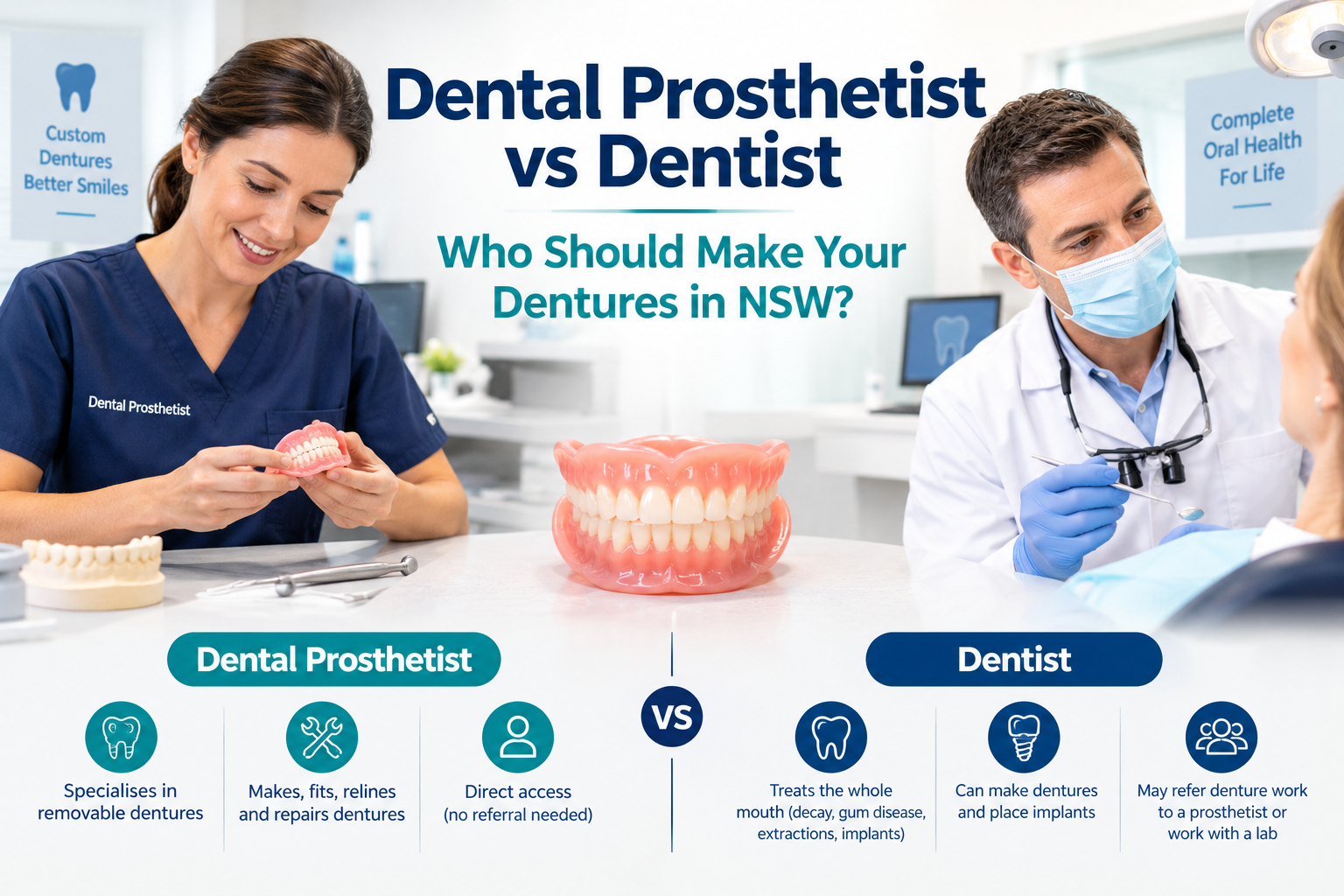
The difference is breadth versus focus. A dentist is trained across all areas of oral health, while a prosthetist specialises in designing, making, fitting and maintaining removable dentures.
What Does a Dental Prosthetist Do?
A dental prosthetist is a registered oral health practitioner trained specifically in removable dentures. In day-to-day work that includes:
- Making full and partial dentures
- Relining, adjusting and repairing existing dentures
- Fitting immediate dentures, usually in coordination with a dentist who performs the extractions
- Making custom mouthguards
Prosthetists see patients directly. They cannot extract teeth, place fillings, treat gum disease or perform implant surgery, and they refer you to a dentist when they find something outside their scope, such as an infection, a suspicious lesion or teeth that need removing. For implant-retained dentures, a prosthetist works within a structured professional relationship with a dentist, as the Dental Board requires.
What a Dentist Brings to the Table
A dentist can provide dentures, but their training covers the whole mouth. That means diagnosing and treating decay and gum disease, removing teeth, screening for oral cancer, and placing or coordinating dental implants. When your mouth needs work before dentures can be made, a dentist does it.
Many dentists make dentures themselves or work with a dental technician in a laboratory. Others refer denture work to prosthetists.
Prosthetist or Dentist: Side-by-Side Comparison
| Dental Prosthetist | Dentist | |
| Registration | Dental Board of Australia (Ahpra) | Dental Board of Australia (Ahpra) |
| Main focus | Removable dentures | All aspects of oral health |
| Makes full and partial dentures | Yes | Yes |
| Relines and repairs | Yes | Yes, often through a lab |
| Tooth extractions | No | Yes |
| Fillings and gum treatment | No | Yes |
| Implant surgery | No | Yes, or via a specialist |
| Referral needed | Generally not | Not required |
Do You Need a Referral for Dentures?
For most people, no. In Australia you can generally book directly with a dental prosthetist without seeing a dentist or GP first. Check with any funding scheme you use, though, as public dental programs and some schemes have their own rules.
If you still have teeth that need extracting, or you have gum disease or other oral health issues, a dentist will need to treat those first. This is where the two professions work as a team: the dentist handles surgery and diagnosis, and the prosthetist handles the denture.
Who Makes Dentures in Australia?
Dentures are made by dentists, dental prosthetists and the dental technicians who build them in laboratories. Only registered practitioners treat patients directly, so when you walk into a clinic you will be seen by a dentist or prosthetist rather than a technician.
Which Path Suits Your Situation?
- Teeth need to come out first: start with a dentist, then work with a prosthetist or dentist on immediate or conventional dentures.
- Existing dentures are loose, cracked or worn: a prosthetist can usually handle relines and denture repair directly.
- Sore patches, white or red lesions or unexplained pain: see a dentist first to rule out other conditions.
- Still weighing up your options: the guide to missing teeth solutions compares dentures, bridges and implants.
- Implant-supported options: a dentist or specialist places the implants, and the denture is made as part of the same treatment plan.
How to Choose a Practitioner Anywhere in Australia
- Verify their registration using the Dental Board of Australia’s public register. Look for the registration type “dental prosthetist” or “dentist.”
- Ask whether dentures are made on site or sent to a lab, and how long repairs and adjustments usually take.
- Ask what follow-up is included, such as adjustments after fitting.
- Request an itemised quote so you can compare fees. Costs vary between clinics, and our dentures cost guide explains what influences the price.
- Check your health fund for rebates and annual limits for the provider type before you book.
Public Dental Care, Private Cover and Regional Access
Medicare does not cover most routine dental care, so many Australians pay privately or use extras cover. State and territory public dental services support eligible concession card holders, but waiting lists vary and the range of treatment differs between jurisdictions.
Distance is a real factor outside the capital cities. Regional and remote patients may travel for specialist steps such as surgery, while denture work is often available locally. Some prosthetists also offer visits to aged care facilities, so it is worth asking if travelling to a clinic is difficult.
Frequently Asked Questions
Can a dental prosthetist remove teeth?
No. Extractions are outside their scope, so a dentist or oral surgeon handles them. The two commonly coordinate so that immediate dentures are ready on extraction day.
Is a prosthetist as qualified as a dentist to make dentures?
They are trained for different scopes. A prosthetist’s training focuses on dentures, and both professions are registered with the same national board and legally able to provide them.
Will my private health fund cover a prosthetist?
Many extras policies do, but rebates and limits differ by fund and policy. Check with your fund before treatment.
The Takeaway
When comparing the two professions, you are choosing between a denture specialist and a whole-mouth clinician. Neither is better in every case. Prosthetists offer direct access to denture care without a referral, while dentists are essential when extractions, gum treatment or diagnosis are involved. Check registration, ask good questions, and match the practitioner to your situation.